
Basketball has traditionally classified players into five positions, point guard, shooting guard, small forward, power forward, and center. While useful as a shorthand, this system falls short of reflecting how modern NBA teams construct rosters today around talent. A center today might shoot threes at high volume while a guard might initiate half of the team’s offense while barely touching the paint.
Rather than relying on the traditional five positions, data can be used to categorize players based on how they actually play. This was done using five seasons of NBA data, from 2021-22 through 2025-26, and then grouping players using k-means clustering.
The basic idea is pretty simple, instead of telling the model that certain players are guards, forwards or centers, the input is information about what those players actually do on the court. The model then groups players who have similar statistical profiles.
To make players with different amounts of playing time comparable, the statistics were converted to a per-75-possession basis.
The clustering considered 11 different measures covering several aspects of the game:
- Scoring: points and field-goal attempts
- Shooting: three-point attempts, three-point attempt rate and true shooting percentage
- Playmaking: assists
- Rebounding: offensive and defensive rebounds
- Defense: steals and blocks
- Free throws: free-throw attempts
- Ball security: turnover percentage
Players with fewer than 500 minutes were excluded so that a small sample of playing time wouldn’t create misleading player types.
A key question in clustering is deciding how many groups to create. 2 to 15 clusters were tested using silhouette scores to measure how well players separated into distinct groups. The highest score came from two clusters, but two groups is too broad to meaningfully describe NBA roles. The decision was made by comparing cluster statistics and whether the resulting groups made basketball sense. Eight clusters provided the best balance. Moving from six to eight separated primary ball handlers from secondary playmakers and elite rim protectors from other bigs. While adding more clusters began creating less meaningful splits based largely on shooting efficiency.
The result was choosing eight for the number of clustered player archetypes.
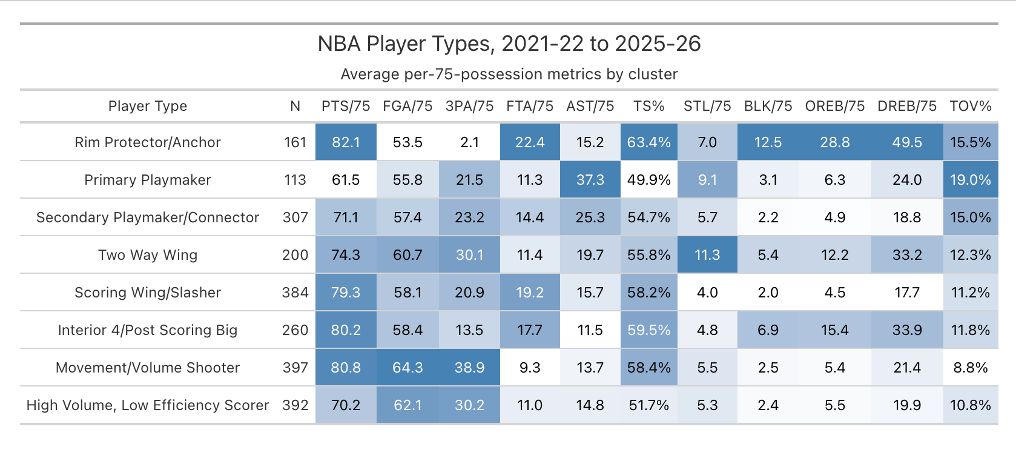
Rim Protector Anchor
Resembles the traditional back-to-basket center, defined by high shot blocking and rebounding, near zero three point volume, and the highest shooting efficiency in the sample. These players anchor a defense and score efficiently near the rim rather than stretching the floor.
Primary Playmaker
Defined by ball handling responsibility, producing the highest assist rate in the sample, paired with the lowest scoring efficiency and highest turnover rate. Value is generated through playmaking volume rather than individual scoring.
Secondary Playmaker/Connector
A well rounded profile across categories. These players facilitate offense without dominating the ball, functioning as connective pieces rather than a primary scorer or distributor.
Two Way Wing
Defined by defensive activity, with the highest steal rate in the sample, strong rebounding for a non-big, and a low turnover rate. A player who contributes on both ends without requiring heavy offensive usage.
Scoring Wing/Slasher
High scoring volume and a strong free-throw rate, but minimal contribution elsewhere, including the lowest defensive and rebounding activity of any type. A pure scorer whose value is concentrated almost entirely in point production.
Interior 4/Post Scoring Big
An efficient scorer who blends moderate rebounding and shot blocking with limited three point range and low playmaking responsibility. Less defensively dominant than the Rim Protector Anchor, but more offensively involved.
Movement/Volume Shooter
Defined almost entirely by perimeter shot volume, featuring the highest three point attempt rate in the sample, with a very low turnover rate and minimal free throw attempts. Offense is generated almost exclusively through outside shooting.
High Volume, Low Efficiency Scorer
A high-usage scorer whose shot volume outpaces shooting efficiency, requiring many attempts while converting at one of the lowest rates in the sample.
These resulting classifications can then be applied to an NBA team’s roster to identify missing roles for drafting or free agency.
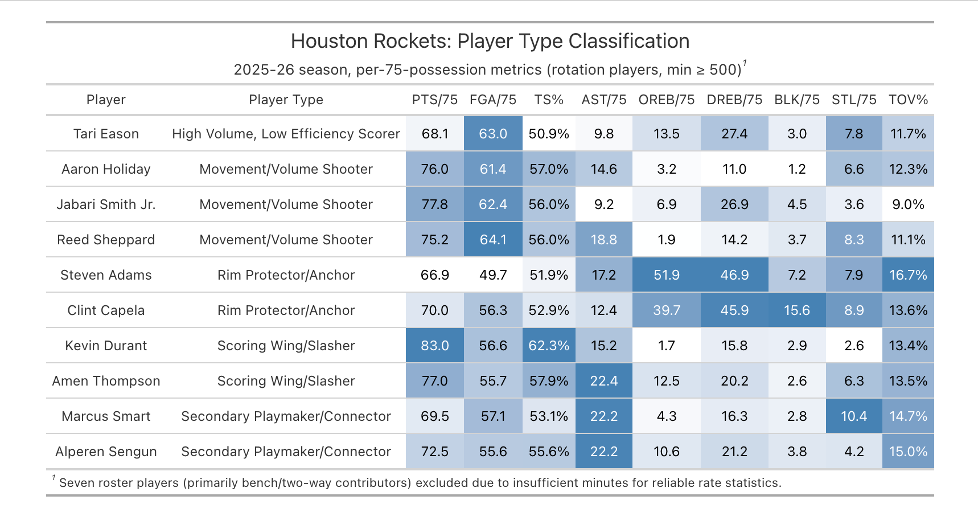
This roster reflects Houston’s current roster as constructed for the 2026-27 season after accounting for this off season’s departures (Dorian Finney-Smith, Josh Okogie) and additions (Marcus Smart, Bogdan Bogdanović) rather than the exact group that played out the 2025-26 season.
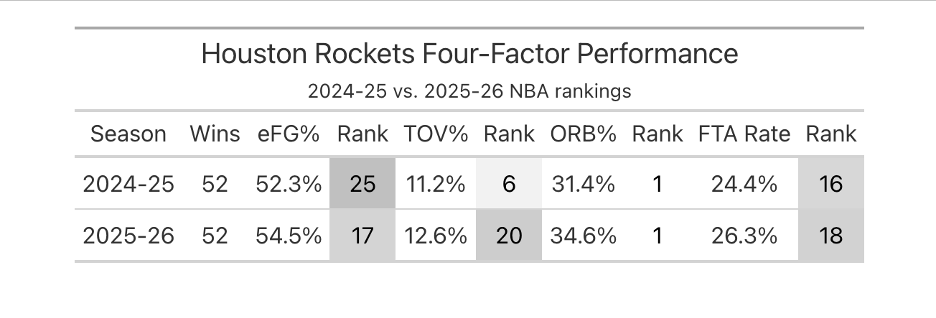
Based on the statistical performance of the Rockets in the standard four factors over the last two seasons, they are a great offensive rebounding team but are a below average shooting team. Houston’s below average effective field goal percentage might have suggested a straightforward roster fix of acquiring more or better shooters. The player type totals complicate this conclusion.
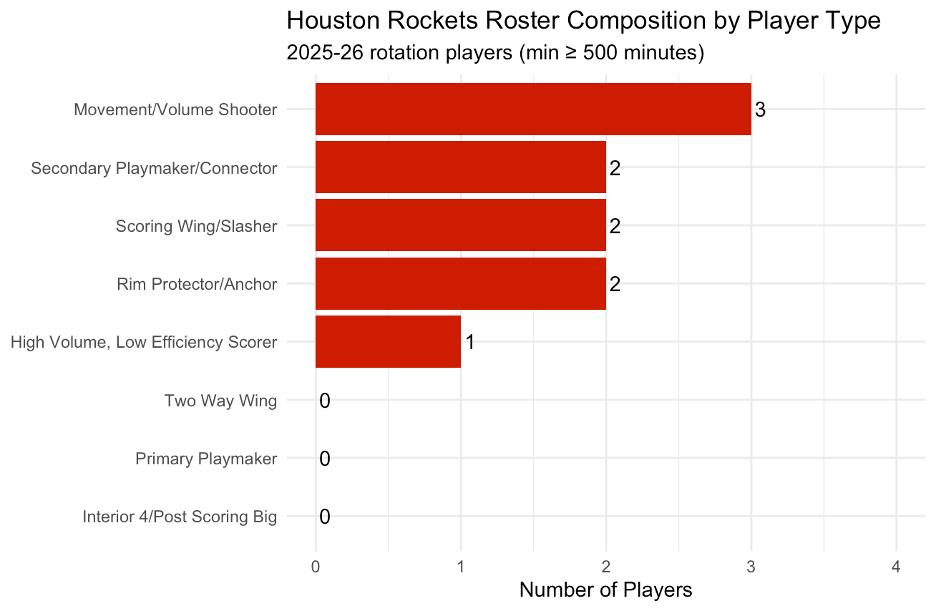
Houston’s roster is already oriented toward scoring and shooting volume, three of ten classified rotation players are Movement/Volume Shooters, and two more are Scoring Wing/Slashers, accounting for half the classified roster. What the roster lacks entirely is a Primary Playmaker. This presents a possible conclusion that the team produced a lackluster eFG% not because they lack shooters but because they lack a primary facilitator to get the shooters great shots. Rather than adding another shooter to a roster that already has multiple, a more direct fix for Houston’s shooting efficiency may be adding a true offensive facilitator.
The Rockets were without PG Fred VanVleet due to injury. This raises the question of whether the Rockets will return a Primary Playmaker from injury. VanVleet’s most recent full season, 2024-25, classifies him as a High Volume, Low Efficiency Scorer rather than a Primary Playmaker. This suggests that even a full recovery may not fully address Houston’s need for a facilitator.
Traditional positions provide a useful shorthand, but they don’t fully capture how modern NBA players contribute on the court. By using statistics and clustering to group players based on their actual production, different player types can better describe the different roles that exist within today’s game. The Rockets provide one example of how this framework can be applied to a real roster, revealing potential strengths and gaps that may not be obvious from traditional position labels alone. More broadly, this approach offers a way to think about roster construction through combinations of skills and player profiles rather than positions, giving teams another tool for evaluating fit, identifying needs, and understanding how different types of players can be used to build a roster.