
Expected goals (xG) and expected assists (xA) have transformed how we evaluate attacking players. Rather than relying solely on goals and assists, analysts can now measure the quality of chances created and finished. The foundational idea is to use a large dataset of historical shots to calculate an expected value of how often a shot from that particular situation results in a goal. Factors commonly used in xG models are shot distance, shot angle, body part used, assist type, and other contextual variables. Each shot is assigned a probability between 0 and 1, this way the quality of chance can be evaluated rather than relying exclusively on goals scored.
But creating a scoring chance in soccer requires more than an assist and shot. So the question is, can attacking contributions be split up to quantify the roles buildup has in creating attacking chances? Existing methods either do not include buildup or award the full shot xG value to everyone involved, greatly inflating the xG values. The goal is to develop individual attacking statistics that include buildup play and provide a way of weighting the buildup portion.
The data used was obtained through the StatsBombR package in R to access Hudl StatsBomb Data. The package provides access to a wide variety of soccer event level data, which was then filtered down to the selected 2022 FIFA World Cup. From the 2022 World Cup data players involved in possessions that resulted in shots were identified to give buildup credit. Rather than focusing only on the shooter and assister, the two models developed also assign value to players who contributed earlier in the attacking sequence.
The first model, Weighted Attacking Value (WAV) uses a weighted approach defined as:
xG + xA + 0.5(xB)
The .5 weight was chosen as a starting point to develop the statistic so the WAV model may benefit from testing other weights in the future.
The second called Split Attacking Value or SAV uses a split credit approach that distributes the possession’s expected goal value among buildup contributors, preserving the total value of the chance. If multiple players are involved in the buildup (excluding the shooter and assist provider), the shot’s xG is split equally among them. For example, if three players are involved, each receives one-third of the shot’s xG as buildup credit.
By doing this we can develop a quantifiable individual attacking statistic for each player during the 2022 World Cup. With single elimination tournaments the total attacking contributions are heavily influenced by how far each player’s team advanced in the tournament. With this in mind the results are more interpretable when normalized to a per 90 minutes statistic. A 120 minute minimum was utilized to remove high production due to low sample size.
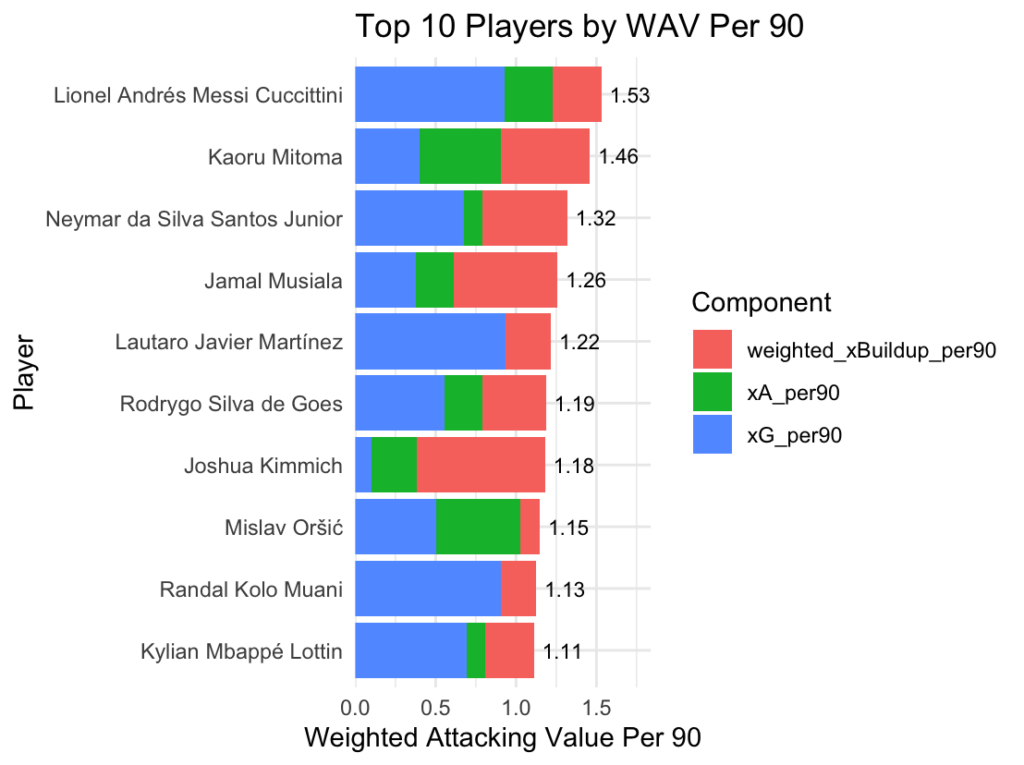
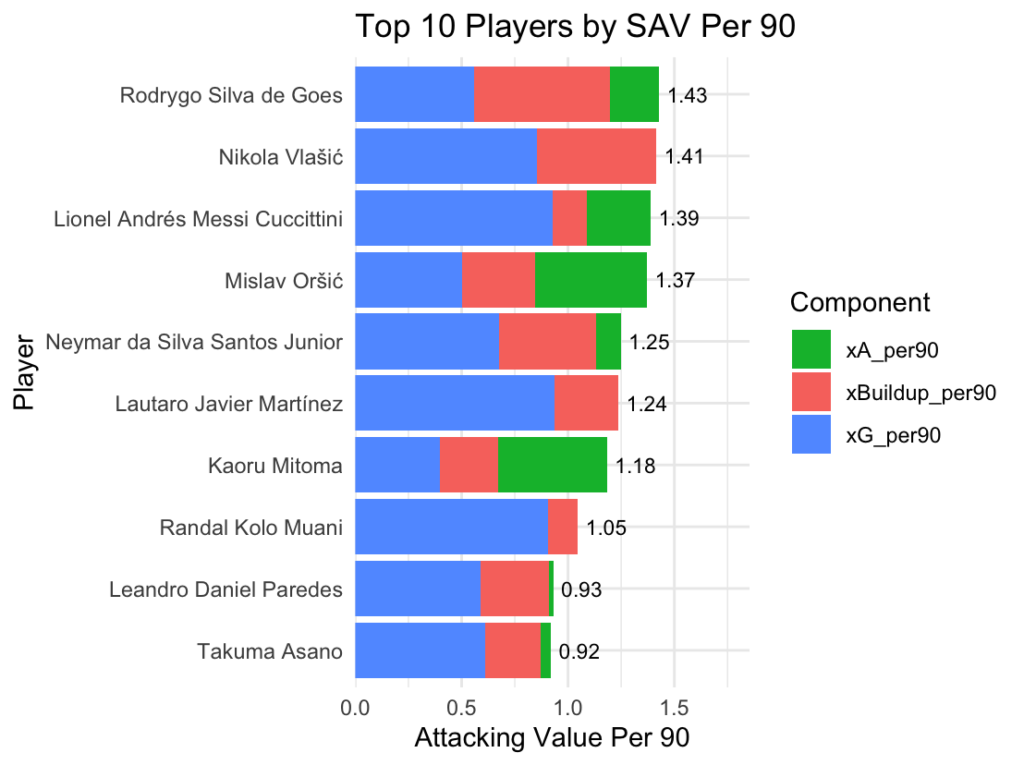
The top ten rankings show clear differences between the two approaches. The buildup component contributes more heavily within WAV, while SAV places greater emphasis on finishing and chance creation. Examining the composition of each player’s attacking value highlights how different player profiles can succeed under both models. Forwards such as Lautaro Martínez and Randal Kolo Muani derive most of their value from finishing actions, while midfielders often display a more balanced contribution across xG, xA, and buildup value.. The results without the buildup components would be different, players like Mitoma, Oršić, Kimmich, and Musiala have large buildup contributions that, if ignored, would place them much lower in the rankings. The two models do produce similar results, several players appear in the top ten across both models. Messi, Neymar, Mitoma, Martinez, Kolo Muani and Rodrygo appear in both lists.
The weighted model tended to highlight players heavily involved in possession progression and circulation, like deeper midfielders and players who frequently touched the ball during attacking sequences. The split credit model aligned more closely with traditional attacking outputs favoring strikers and other forwards while still recognizing buildup contributors.
Correlations
| Variable | xG | xA | Weighted Buildup | Split Buildup | Weighted Metric | Split Metric |
| xG | 1 | .39 | -.05 | .1 | .6 | .87 |
| xA | .39 | 1 | .03 | .07 | .49 | .64 |
| Weighted Buildup | -.05 | .03 | 1 | .61 | .73 | .2 |
| Split Buildup | .1 | .07 | .61 | 1 | .53 | .47 |
| Weighted Metric | .6 | .49 | .73 | .53 | 1 | .78 |
| Split Metric | .87 | .64 | .22 | .47 | .78 | 1 |
One of the most important questions around adding a buildup component when evaluating individual attacking contributions is if it quantifies a unique aspect of play or if it overlaps heavily with the other components. Both xG and xA exhibit near zero correlations with the weighted buildup metric (r = –0.05 and r = 0.03), demonstrating that buildup represents a separate dimension of attacking contribution that is distinct from finishing or assisting actions. The split buildup metric correlates moderately with weighted buildup (r = 0.61), but is only weakly associated with xG (r = 0.10) and xA (r = 0.07). The low correlations suggest that buildup captures a different phase of attacking play than finishing and assisting alone.
The weighted metric balances finishing and buildup involvement, while the split model aligns more closely with traditional attacking outputs. Although the two metrics are strongly correlated (r = 0.78), they reward different player profiles and provide different perspectives on attacking value.
The evidence of buildup being a distinct variable in attacking valuation supports the inclusion of buildup variables in player evaluation frameworks and suggests that relying exclusively on shooting and assisting metrics may overlook valuable contributors within attacking possessions. This not only captures value missing from traditional xG models but also preserves the xG values against the inflation of existing models that award full xG value to those in the buildup.
Between the two models the split value may function better as they are currently constructed since it preserves possession value, avoids inflation and rewards buildup. Utilizing the weighted model with a .5 coefficient as described in this report still produces some inflation. The weighted model will still provide value in usage, especially in scouting. It is useful in its ability to identify undervalued possession contributors, highlight players overlooked by xG and xA and can be useful for evaluating midfielders and other deep lying playmakers.
While neither metric fully captures every aspect of attacking play, both demonstrate that buildup involvement contributes meaningful information beyond traditional xG and xA. Future improvements could account for pass sequence importance, field location, or progression value, allowing buildup contributions to be weighted according to their impact on chance creation. As soccer analytics continues to evolve, recognizing the players who make scoring opportunities possible may be just as important as evaluating the players who finish them.
References
Rathke, A. (2020). StatsBombR: Access to the StatsBomb Open Data API (R package version 0.1). Retrieved from https://github.com/statsbomb/StatsBombR
StatsBomb. (2022). StatsBomb Open Data: FIFA World Cup 2022. https://statsbomb.com/open-data/