
The MLB needs a new CBA ahead of the 2027 season and the hot button issue remains the prospect of a reduced salary cap. In no other U.S. major professional league are there nearly $300 million differences in salary expenditure between teams each year. The back to back World Series titles for the Dodgers have further amplified the debate. This begs the question, does higher salary spending align with more wins, and if so, how strongly? Each observation below represents the total salary expenditure plotted against the total wins for each team for the 2020 through 2025 MLB seasons. This is done using salary and wins data collected from Spotrac. (Spotrac, 2020, 2021, 2022, 2023, 2024, 2025)
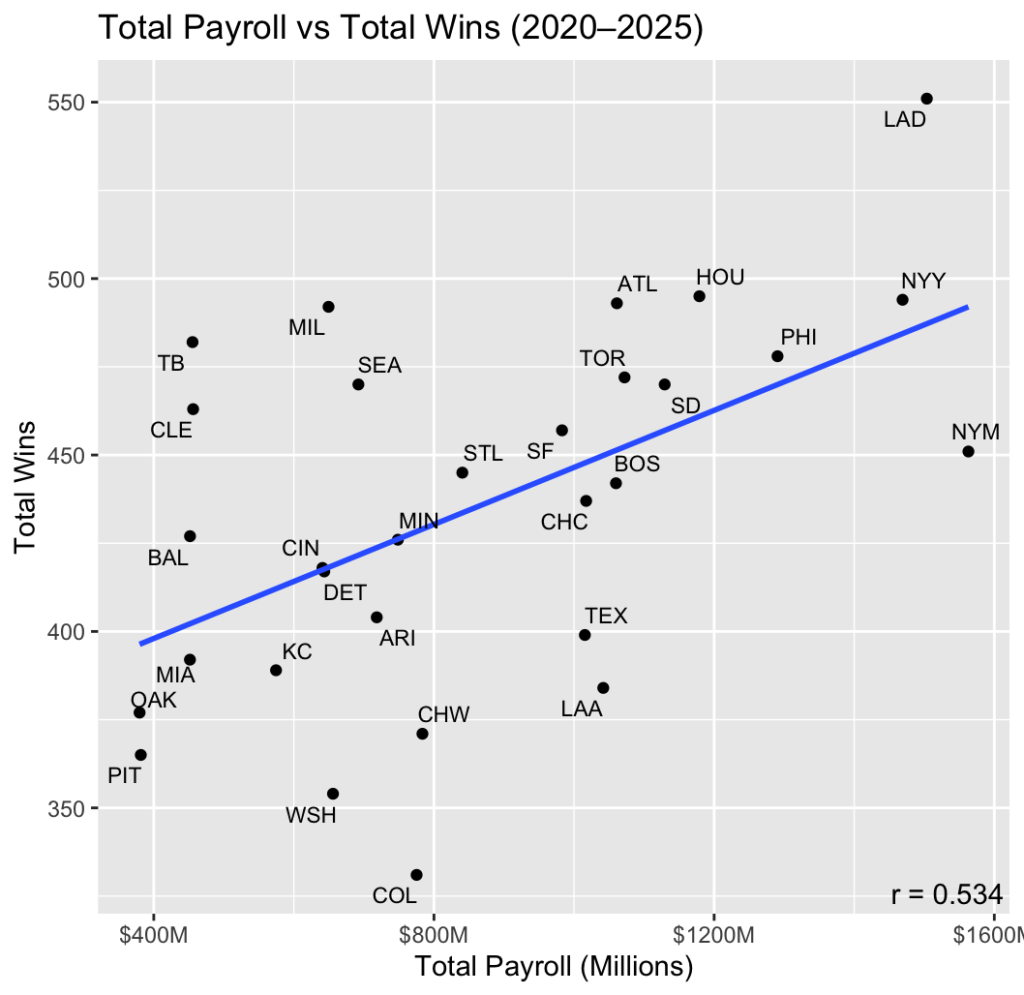
Plotting the teams expenditures and wins across the six year time span results in a calculated correlation value of .534. In simple terms, that represents a moderate positive linear association. Meaning as the payroll increased the observed teams tended to win more. While other factors certainly impact winning, the data does say that a moderate relationship does exist. The benefits of spending may not be perfectly linear but an increase in spending had a correlation with winning. The trend line is easy to follow but variations among similar teams exist. For example while the Nationals and Brewers spent similar amounts of money over the studied period, they fared differently in on field success.
There is a potentially meaningful finding that amongst the highest spending teams, there were not any losing teams over this stretch of time. The Mets may have underperformed their predicted wins on the line of best fit. But relative to other teams they were not a losing team. That may be an argument in favor of a lower/stronger salary cap to limit the possibility that certain high spending teams are always good in the interest of league parity.
| Year | Correlation |
| 2020 | 0.238 |
| 2021 | 0.518 |
| 2022 | 0.592 |
| 2023 | 0.197 |
| 2024 | 0.382 |
| 2025 | 0.509 |
| Average | 0.406 |
These are the correlations per individual season then averaged across each of the individual seasons. The correlations vary greatly and that provides some value about the relationship between payroll and wins in a smaller sample size. There is a lot of single season noise that affects the correlation values like injuries, hot streaks or just luck. The data paints a picture that makes some sense. Over an extended period, higher spending is associated with higher win totals. But it certainly is not the whole story.
Ahead of the CBA there is an argument to be made for either case. There is a moderately strong observable relationship between wins and spending over an extended period of time. But within a season that relationship does not matter as much. Teams can over or underperform each year regardless of spending. In the end spending does matter, especially in the long term. So there is reason to believe that a lower salary cap could lead to better parity and possibly a better product. But it has not made player selection unimportant, teams still win or lose on their own decision making. Money can buy talent but talent does not gurantee wins.
References
Spotrac. (2020). 2020 MLB team salary payroll tracker. https://www.spotrac.com/mlb/payroll//year/2020
Spotrac. (2021). 2021 MLB team salary payroll tracker. https://www.spotrac.com/mlb/payroll//year/2021
Spotrac. (2022). 2022 MLB team salary payroll tracker. https://www.spotrac.com/mlb/payroll//year/2022
Spotrac. (2023). 2023 MLB team salary payroll tracker. https://www.spotrac.com/mlb/payroll//year/2023
Spotrac. (2024). 2024 MLB team salary payroll tracker. https://www.spotrac.com/mlb/payroll//year/2024
Spotrac. (2025). 2025 MLB team salary payroll tracker. https://www.spotrac.com/mlb/payroll//year/2025